Deities (and Associated Religions) commonly associated with Satan(ism)


 Printer Friendlier Version

<<< back to [Home]

Introduction
Aten
Lucifer
           Introduction
           Saint Lucifer
           Traditional Luciferianism
           Albert Pike
           Modern Luciferianism
                       Church of Lucifer
                       Children of the Black Rose
           Gnostic Luciferianism
           Church of Azazel
           LaVey Satanism
           Anthroposophy
           The Process Church of The Final Judgement
           Diana Lucifera
           Feri Witch Tradition
           Scientific Terminology
Set
Ba'al
Ishtar
Lilith
Samael
Baphomet
Pan
Leviathan
Tiamat
Nammu
Enki
Prometheus
Deities - General Comments


Introduction:

Christians associate a number of historical (often pagan) deities with being 'The Devil'. These may a number of Egyptian, Roman and Greek pagan Gods, and others, including Ba'al, Set, Aten the Sun God, Lucifer, Pan and many others. Please see the link below for a 'complete' list.

http://en.wikipedia.org/wiki/Devil

Clearly some of these Gods have been historically (and probably still are) worshipped in Masonic Lodges and are seen as different aspects of the Supreme Being. Ironically, some Christians and Satanists are both panentheists and monists. The reason for much of the debate on the subject as to whether a deity being worshipped is in fact Satan or not results in the fact that the followers of the deities in question do not see their chosen God as the Biblical definition of Satan, with the relationship to the Hebrew God and Jesus. We examine below some of the deities commonly associated with being 'Satan', and examine the cultural origin of the deity and those that use the deity in their belief system. It should be noted that whilst there may well be links between the various deities and Theistic or indeed LaVey Satanism, some of the religions or groups are not necessarily associated with the Church of Satan. These groups are described in as much detail as possible to aid in readers' general understanding of them.

back to top

 
Aten:


The worship of Aten, for example, in Ancient Egypt approximately 3500 years ago, is regarded as one of the first monotheistic religions. It was short lived, and fizzled out, on account of the 18th Dynasty Pharaoh Akhenaten's obsession with demonstrative sacrifices of food, and insistance on having his people build a new city, resulting in starvation and ill health of his city. Whilst monotheistic, he elevated his and his wife's status as near God-like, and the human representatives of Aten on earth. Having forced Eyptians to break with tradition and worship this particular deity, and caused huge suffering as part of his religious revolution, they tried to erase him from history after his death. It is claimed by some that Psalm 104: 20-30 is actually based on a poem by Akhenaten to Aten, a declaration of love for his God, but was appropriated by Christians and used in a Christian context.

http://en.wikipedia.org/wiki/Aten

http://en.wikipedia.org/wiki/Akhenaten

It could be argued that Aten was not the 'Devil' as such, but just one of the pagan Gods that the ancient Egyptians worshipped, that happened to be the enforced flavour of the month for a while in Egypt.

The Sun God has been worshipped in various forms throughout history and pre-history, and the exact practices and beliefs of course vary slightly.

back to top

 
Lucifer:
 
Introduction:

Lucifer is the word meaning 'light bearer' (from lux, lucis, "light", and ferre, "to bear, bring"), a Roman astrological term for the "Morning Star" the planet Venus. The word Lucifer was the translation of the Septuagint Greek heosphoros, ("dawn-bearer"; cf. Greek phosphoros, "light-bearer"; itself the translation of the Hebrew Helel ben Shahar, Son of Dawn), used by Jerome in the Vulgate, having mythologically the same meaning as Prometheus who brought fire to humanity.

http://en.wikipedia.org/wiki/Lucifer

Below is a 2nd-century sculpture of the moon goddess Selene accompanied by Hesperus and Phosphorus: the corresponding Latin names are Luna, Vesper and Lucifer.
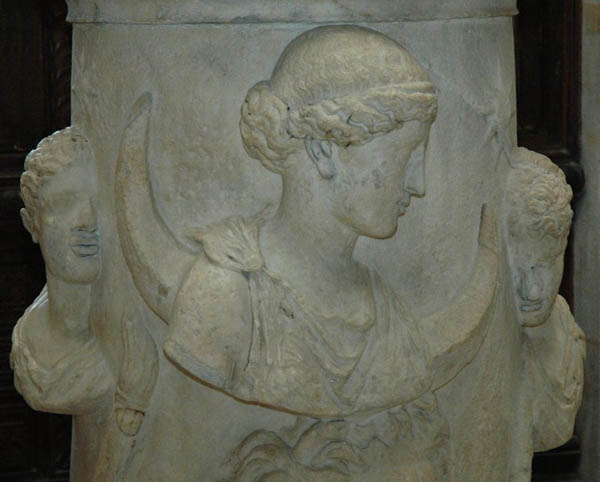


One form of phosphorus (white phosphorus) emits a faint glow upon exposure to oxygen (hence its Greek derivation and the Latin 'light-bearer', meaning the planet Venus as Hesperus or "Morning Star").

Two illustrations of Satan/Lucifer by Gustave Doré's for the 17th Century work Paradise Lost by John Milton, are shown below.


A statue of one of twelve Lucifers on the (Catholic) Holy Trinity Column in Olomouc in Olomouc (Czech Republic), built in the 18th Century, is shown below.


A statue of Lucifer, by Guillaume Geefs (Cathedral of St. Paul, Liège, Belgium), from the 19th Century, is shown below.


The Sigil of Lucifer, used by Theistic Satanists and some Luciferians and Gnostic Luciferians, is shown below.


Before we examine the deities and religions around Lucifer, let us first examine the Biblical references to 'Lucifer'.

The context in which 'Lucifer' is mentioned in the Old Testament is probably not in the role of 'the Devil'. e.g. Isaiah 14:12. (KJV): 'How art thou fallen from heaven, O Lucifer, son of the morning! how art thou cut down to the ground, which didst weaken the nations!'

The articles below examine the translation of Isaiah 14:12. The first article examines other references in the NT for Satan and how they associate Satan with lighting and light, and examines Isaiah's use of Lucifer, which is most likely to actually symbolically refer to the Babylonian deity morning star that is not able to help the rogue Babylonian king, and not actually the Devil himself.

www.crivoice.org/lucifer.html http://www.crivoice.org/lucifer.html

www.lds-mormon.com/lucifer.shtml

The link below explains how the use of Lucifer here was a mistranslation by Jerome who finished The Latin Vulgate Bible in 405 AD. He mistranslated the word 'Heylel' to mean 'Lucifer'. Heylel is claimed to be derived from the root word 'halal' which is used 165 times in the OT, and translated in a number of different, often contradictory ways, but certainly with no reference to 'Satan' or a Babylonian God.

www.israelofgod.org/lucifer.htm

It is alleged in the Latin Vulgate, in 2 Peter 1:19 and Revelation 22:16, 'Lucifer' is used to refer to Jesus Christ. The KJV uses the terms 'day star' and 'morning star' in these passages respectively. The KJV is quoted below, where Jesus is referred to as the 'morning star'.

Revelation 22:16: 'I Jesus have sent mine angel to testify unto you these things in the churches. I am the root and the offspring of David, and the bright and morning star.'

2 Peter 1:19: 'We have also a more sure word of prophecy; whereunto ye do well that ye take heed, as unto a light that shineth in a dark place, until the day dawn, and the day star arise in your hearts:'

Revelation 2:

24: 'But unto you I say, and unto the rest in Thyatira, as many as have not this doctrine, and which have not known the depths of Satan, as they speak; I will put upon you none other burden. 25: But that which ye have already hold fast till I come. 26: And he that overcometh, and keepeth my works unto the end, to him will I give power over the nations: 27: And he shall rule them with a rod of iron; as the vessels of a potter shall they be broken to shivers: even as I received of my Father. 28: And I will give him the morning star.

29: He that hath an ear, let him hear what the Spirit saith unto the churches.'

Lucifer is known as the 'God of Morning Light', the bringer of illumination, wisdom and knowledge, etc. and has its origins with the Roman God Venus. There are many types of Luciferianism so it is easy to confuse them. This section aims to explain the difference between the Luciferian Sects. Historically speaking, there is no direct connection between the Roman God Venus and Luciferianism as it exists today. Most Luciferian Sects do not recognise Jesus Christ with the exception of Gnostic Luciferianism and those historical followers of Saint Lucifer (Lucifer Calaritanu). Strictly speaking, Gnostic Luciferianism recognises the Gnostic Jesus as opposed to the New Testament Christian view of Jesus. Also Gnostic Luciferianism differs from all other forms of Luciferianism in that it regards the creator of the world and indeed Universe as Demiurge, whereas other types of Luciferianism usually associate this with the main deity they worship (e.g. the Grand Architect of the Universe and purveyor of wisdom). Gnostic Luciferians may also surprise some Christians as much of what they say appears almost identical to that of Gnostic Christianity or progressive Christianity. Clearly it depends on context and at other times Gnostic Luciferians may also sound like Satanists.

Luciferianism is often identified as an auxiliary of Satanism, due to the popular identification of Lucifer with Satan. Some Luciferians accept this identification or consider Lucifer as the light bearer aspect of Satan, or even as equivalent to Satan, and thus could properly be called Theistic Satanists. Others reject it, arguing that Lucifer is a more positive ideal than Satan. They are inspired by the ancient myths of Egypt, Rome and Greece, Gnosticism and/or traditional Western occultism.

http://en.wikipedia.org/wiki/Lucifer

The term Lucifer is often used interchangeably with Satan by most modern Christians and also the general public, although this has not always been the case. Some elements of Orthodox Christianity perhaps associated Lucifer with 'Satan before the fall', i.e. the angel Satan. However the term Lucifer was not universally understood in this context. It is more likely it became associated with Satan through a misinterpretation of the context in which it is mentioned in the King James Bible (as described above). As Bishop (later Saint) Lucifer's name attests (see below), Lucifer was not yet associated with 'Satan' in the 4th century.

Below we shall examine the different types of Luciferianism, to provide a better and deeper understanding of this area for the unfamiliar.

back to top

 
Saint Lucifer:

The term 'Luciferians' is was used to describe a Schismatic Christian group named after Lucifer Calaritanus, Bishop of Cagliari, Sardinia in the late 4th century. He was made a saint, Saint Lucifer. The movement was linked to the complex political machinations involving the emperor Constantius II and Pope Liberius. Lucifer was a staunch ultra-orthodox opponent of Arius (founder of Arianism - the philosophy opposed to the Trinity) - Arius was declared a heretic by Orthodox Christianity. The Luciferian movement died out early in the 5th century. All that we ascertain of Bishop Lucifer's views derive from the anti-Luciferian polemic of Jerome in the form of a dialogue, Altercatio Luciferiani et orthodoxi ("Altercation of the Luciferian and the orthodox"). Mentioning St Lucifer in this context is perhaps an anomaly as these Luciferians really have nothing whatsoever to do with Traditional and Modern Luciferianism except for the fact that for St Lucifer's name - he could just as well have been called Michael and it would have had no impact on his ideas or followers (mostl likely). The name 'Lucifer' at this time did not appear to have any 'Satanic' connotations.

http://en.wikipedia.org/wiki/Lucifer_Calaritanus

http://en.wikipedia.org/wiki/Jerome

http://en.wikipedia.org/wiki/Luciferian

back to top

 
Traditional Luciferianism:

Traditional Luciferianism was a (heretical) pantheistic thirteenth-century German sect which held that Lucifer should be worshiped as the ruler of the material world. This concept of the material world as Lucifer's domain was, most likely, taken from Catholic Christian doctrine and his titles in the (presumably Latin Vulgate) Bible as 'the god of this world' in 2 Corinthians 4:4 and 'lord of this world' in John 12:31. The KJV version is shown below.

www.spiralnature.com/spirituality/satanism/luciferianism.html

John 12:31 (KJV): 'Now is the judgment of this world: now shall the prince of this world be cast out.'

2 Corinthians 4:4 (KJV): 'In whom the god of this world hath blinded the minds of them which believe not, lest the light of the glorious gospel of Christ, who is the image of God, should shine unto them.'

Presumably this Sect regarded Jesus as a false messiah, although this is speculation and I do not have any further information on this.

back to top

 
Albert Pike:


Lucifer is the God described by the famous Grand Commander of the Scottish Rite, Southern Jurisdiction, Albert Pike, in the Scottish Rite book Morals and Dogma.

http://en.wikipedia.org/wiki/Luciferianism

In the Instructions to the 23 Supreme Councils of the World, July 14, 1889, Albert Pike was recorded by A.C. De La Rive in La Femme et l'Enfant dans la FrancMaconnerie Universelle on page 588 as having said:

'That which we must say to a crowd is - We worship a God, but it is the God that one adores without superstition. To you, Sovereign Grand Inspectors General, we say this, that you may repeat it to the Brethren of the 32nd, 31st, and 30th degrees - The Masonic Religion should be, by all of us initiates of the high degrees, maintained in the purity of the Luciferian Doctrine. If Lucifer were not God, would Adonay whose deeds prove his cruelty, perdify and hatred of man, barbarism and repulsion for science, would Adonay and his priests, calumniate him? Yes, Lucifer is God, and unfortunately Adonay is also god. For the eternal law is that there is no light without shade, no beauty without ugliness, no white without black, for the absolute can only exist as two gods: darkness being necessary to the statue, and the brake to the locomotive. Thus, the doctrine of Satanism is a heresy; and the true and pure philosophical religion is the belief in Lucifer, the equal of Adonay; but Lucifer, God of Light and God of Good, is struggling for humanity against Adonay, the God of Darkness and Evil.'

Adonay is the Hebrew word for Lord, used to describe either the Hebrew God 'Yaweh' or Jesus Christ.

In a letter dated 15 August 1871, addressed to Grand Master Guiseppie Mazzini 33° (Archives British Museum, London, England), Albert Pike wrote:

'We shall unleash the Nihilists and Atheists, and we shall provoke a formidable social cataclysm which in all its horror will show clearly to the nations the effects of absolute atheism, origin of savagery and of the most bloody turmoil. Then everywhere, the citizens, obliged to defend themselves against the world minority of revolutionaries, will exterminate those destroyers of civilization, and the multitude, disillusioned with Christianity, whose deistic spirits will be from that moment without compass, anxious for an ideal, but without knowing where to render its adoration, will receive the pure doctrine of Lucifer, brought finally out in the public view, a manifestation which will result from the general reactionary movement which will follow the destruction of Christianity and atheism, both conquered and exterminated at the same time.'

Other quotes from Morals and Dogma about Jesus can be found at the links below. Pike regarded Jesus at most to be a man, and accused him of being an atheist, a blasphemer, the god Hercules, the founder of a religion of hate etc.

http://home.computer.net/~cya/cy00051.html

http://ritualabusefree.org/Immorals%20and%20Dogma.htm

An extract from Albert Pike's Morals and Dogma book is shown at the link below, containing references to the Greek God Prometheus.

www.illuminati-news.com/e-books/morals-dogma/apike12.htm

Some classically-educated Freemasons and those inspired by their work claim to use 'Luciferian' in the scholarly sense of 'bringing enlightenment', invoking the Greek deity Prometheus. Whether these individuals were Gnostic Luciferians or just Prometheus worshippers is not certain. The implication from Albert Pike's writings in general is that he was some manner of polytheist, interested in Egyptian mysticism, with a particular anti-Christian reactionary stance. Whilst literal interpretation of his words might assume he was referring to Lucifer as a literal deity, like Adonay, those who are familiar with Pike's works would interpret this metaphorically, meaning Lucifer as a reflection of the light of the self and the light of Wisdom. Whether he was viewing the 'Grand Architect' as being the 'God' he hated or not is unclear. He used Baphomet as a symbol of resistance against Chrsitianity so perhaps Lucifer was used in the same way. Pro-Catholic polemicists linked such masonic usage with Sects worshipping Lucifer, which have had persistent groups of followers since the Middle Ages.

http://en.wikipedia.org/wiki/Luciferian

In Greek mythology, Prometheus (in Ancient Greek meaning "forethought") is a Titan known for his wily intelligence, who stole fire from Zeus and gave it to mortals for their use. His myth has been treated by a number of ancient sources, in which Prometheus is credited with (or blamed for) playing a pivotal role in the early history of humankind. Prometheus is associated with technology and science, embodying some qualities of the Theistic Satan. However, Prometheus is not generally worshipping by Theistic Satanists or pagans, but is worshipped by some modern Gnostic Luciferans.

http://en.wikipedia.org/wiki/Prometheus

www.theisticsatanism.com/CoAz/belief/risingGods.html#Prometheus

Quoted from Diane Vera's web site:

'In Polytheistic Satanism, Satan is still the main focus of reverence, but is seen as one of many gods. The gods of many non-Abrahamic cultures are believed to exist and are not seen as mere servants of either Satan or Jehovah. In many though not all forms of polytheistic Satanism, Satan Himself is seen as the Christian-era manifestation of some known ancient pre-Abrahamic god, such as Set, Pan, Prometheus, Shiva, Loki, or Enki. Polytheistic Satanism overlaps with pantheistic Satanism, insofar as some polytheists are also pantheists or otherwise embrace the idea that all the many gods are facets of an underlying One. But polytheistic Satanism also includes hard polytheists, who see the gods as distinct entities and not facets of the One.'

www.angelfire.com/ny5/dvera/varieties/index.html

back to top

 
Modern Luciferianism:

Modern Luciferianism is a similar theology to Traditional Luciferianism, usually modelled on a panentheistic view of Lucifer as being all encompassing essence of the Universe (an essence or God that pervades the Universe, but which makes up each person, each person having the potential to become 'God' or 'a God'). The lines between Modern Luciferianism and Gnostic Luciferianism are often somewhat blurred. Some examples of Modern Luciferian groups are listed below.

www.spiralnature.com/spirituality/satanism/luciferianism.html

www.geocities.com/lordforbidon/main

www.conspiracyarchive.com/Commentary/Luciferianism.htm

http://zephret.livejournal.com

Luciferianism is the product of 'religious engineering', which sociologist William Sims Bainbridge defines as "the conscious, systematic, skilled creation of a new religion" in his book New Religions, Science, and Secularization".

http://en.wikipedia.org/wiki/William_Sims_Bainbridge

Helena Blavatsky, the founder of the Theosophical Society (Theosophy), established an occult magazine entitled 'Lucifer' in London in 1887.

http://blavatskyarchives.com/luciferreprints.htm

www.theforbiddenknowledge.com/hardtruth/prophetsindex.htm

 
The Church of Lucifer:


The Church of Lucifer, a Modern Luciferian organization, which views Lucifer as a symbol of the never-ending quest for wisdom and a force of and behind particular aspects of nature, has been active for since the late 1980s in the USA and to a lesser extent internationally. Founded by the late Rev. Robert Stills and passed on to Frederick Nagash, the Church of Lucifer is currently administered by Rev. Frederick Nagash, Rev. Satrinah Nagash and Rev. Maskim Xul. The organization encourages the study of several ancient cultures to learn its wisdom and incorporate that into the Luciferian's own repertoire. The Twin Goats symbol of the Church of Lucifer is shown above, incorporating the normally Theistic Satanic inverted pentagram. Are the goats supposed to represent the deity Baphomet? Or is there anothe significance? The Lucifer that is worshipped here is conceptually similar to that of Theistic Satanists, although it is perhaps less 'dark' in nature, and Luciferians deny any direction connection with Satan. The two are regarded as separate entities. These Luciferians are however as anti-Christian (anti-Jesus) as Theistic Satanists. The Church of Lucifer is allied to the First Church of Satan, the Theistic Satanic organisation.

www.luciferian.org

www.luciferian.org/index.php?col=liberation
A list of FAQs about Luciferianism and the COL can be found at the link below. Nagash denies that the COL is a mixture of Left and Right-Hand Paths and that such a concept is to create a diametrically opposed and contradictory anti-religion. Perhaps this is a reference to or dig at some of the Gnostic Luciferian groups that are less narrow minded or more heterogenous, drawing on different religions for inspiration. The COL is opposed to all religions. Nagash believes that Luciferianism is a very old philosophy, based on Greco-Roman and Egyptian mystical traditions, whereas he views LaVey Satanism and Wicca as modern 'religions', the latter being reconstructionist.

www.luciferian.org/index.php?col=faqs

An article 'Luciferianism: The Scales of Balance and Justice' by Rev. Frederick Nagash can be read at the link below.

www.luciferian.org/index.php?col=scales

A compilation of various articles by Nagash can be found at the link below. Some of it reads similarly to the subject headings in LaVey's Satanic Bible. The article Secrets to Successful Magick can be found on page 54-55.

www.scribd.com/doc/3231915/Church-of-Lucifer

This article is reproduced below.

'Magick cannot be condensed into merely one volume of work; it has a broader perspective than that. Yet, I will keep this essay short, just to give the initiate somewhat of an idea of our workings. Our magick has a deep base in Draconian/Astral workings. Initiates of our Order will find the basics of our magick more difficult than some of our high magick due to a singular point: The beginning of any ones magickal journey is a rocky one, to say the least. The initiate must be able to control his/her mind and body completely before he/she can move any further. To properly perform any type of magick, the initiate must have strong mental focus, devoid of any distractions or emotions but the desired effect. For magick to be worked properly, the initiate must not have mental problems, or the end result could be horrifying and damaging to both the initiate and the Order.

"Black Magick", as it is coined, has the sole purpose of self-gratification, as opposed to "White Magick", which is used in the gratification of others. The Magick of the "Left hand path" is a form of Black Magick and "Torelian Magick" is a form of the Left Hand Path. Torelian magick is not the only spectrum of the occult universe we study, but it is our primary focal point. "Torelia" is a plane of travel I found during astral projection. It is multifaceted in its use. I have performed conjurations with 100 percent clarity, which is something I had been struggling with for some time. I have awakened my inner god, and I have spoken with the spirits of the dead (Necromancy).

The occult's uses are in tact for the primary use to seek vast knowledge, or just knowledge of one's self. It is a vast universe filled with many obstacles along the way. After these hurdles, so to speak, are jumped, the world is yours to explore. And what a fascinating place it could be!!!

There are many things that you learn in magickal texts...How to set up an altar. What implements you may need. Ingredients for various rites, and etc. They tell you everything you need to know about how the rite works. Even though you may do everything that that book may say, but you still don't succeed. No one can figure out what they did wrong.

Well, there is something things books will never tell you. And that is what this class is about. These 'secrets' are within yourself. Your ego and your confidence. Books will never tell you how to use these things, nor will they tell you that they are essential. It is the main Secret behind successful magick.

Have you ever talked to someone who is very successful? Don't they seem to be conceited? I know I have run into that many times. That is their confidence at work. But confidence can hurt you too. But first, I will explain what good confidence is, and then how over confidence can hinder you.

Good Self Confidence. It is when you are not afraid of anything, when you don't doubt yourself, or anything you do. It is the part of you that says "You can do it" and it drives you towards your goals no matter what they may be. Now, some people may seem like they have good confidence, but in reality, they inwardly doubt. These are the magickians with a 50/50 success rate. Their self-esteem on the outside seems good, but inside, they still doubt. Those will low self confidence and low self-esteem are those whose magick will never work. This is because they don't see themselves highly, nor do they think that they can do it. Overcoming this is a major part of magickal development.

How to achieve this varies from person to person. But to start, you must believe in yourself. You must know that what you are doing is going to work, and never doubt that in your head. The Daily Ritual of Reawakening is a good start for building your confidence, for in that right, you are proclaiming that no on shall remove you from your throne.

Now how overconfidence works against you. When you are over confident, you think that you are invincible. Magickally speaking, there is always someone better than you in the world somewhere. There is a point however, when you are almost undefeatable...by that, it means that the one you are warring with will receive damage, but so will you. And that weakens you. If you keep that up, you will weaken yourself, even though you think you are strong and powerful...then you try a rite, where you have to be in full strength, then you hurt yourself really bad. This goes many ways. Confidence is good, over confidence is detrimental.

As far as ego is concerned...It is similar to the confidence thing. However, ego most times is bad. To big of an ego will cause you to lose more than win. Xtians have that problem with their self-righteous bull. Wicca is the same way. They do magick, and they are white light so that gives them an ego that they are "Good". The satanic ego, which is different from every other ego there is. This is because we are considered not like everyone else or freaks, our egos must be different. We have to have an ego, yet still be approachable. I think that explains itself.

Another secret to successful magick that I did not mention is the accentuation of various parts of the ritual. The words, how it is worded, etc. For example, when doing a Black Mass, you need to make sure that the Four Crown Princes hear you, know that you are paying a tribute to them for their services, even though you commanded them to do so. Respect is a major aspect of the accentuation. This also applies other types of rituals. Such as healing, you want to make sure the person or yourself gets healed, you need to accentuate that. Or if you are trying to attain something, be it spiritual or material. You need to accentuate your goal.

Accentuations also include pronunciation. IF you are working in magickal languages, such as enochian, or sumerian, etc, you have to say them right for it to work. If you don't, then the spirit or entity you are talking to or commanding will not understand you, therefore, not complete what you are asking.

These are the little known secrets of magick and what makes it successful.'

 
The Children of the Black Rose:


The Children of the Black Rose, aka Church Lucifer, are a long-time Luciferian order who view Lucifer as a Supreme being encompassing all; "everything and nothing." The illustration of Lucifer taken from the Church Lucifer web site is shown above, presumably similar in concept/image to Eliphas Levi's Baphomet.

The originator of the Children of the Black Rose is Father Nate Leved, author of The Seven Scrolls of the Black Rose. The book was published in 2002, and can be viewed for free on line. His writings date back presumably to 1988.


http://slickaz.tripod.com/cl/cbr1.html

http://slickaz.tripod.com/cl/chluc1.html

back to top

 
Gnostic Luciferianism:

Gnostic Luciferianism is quite different (in theory) to all other forms of Luciferianism discussed in this section, and as such, have been moved to it's own dedicated page, entitled Gnostic Luciferianism and Bestian Gnosticism. Those that come under the Gnostic Luciferian umbrella and associate with related groups are often not actually literal Gnostics, and some are just 'modern' Luciferians, pagans and Satanists wanting a little more than just hedonism.

back to top

 
Church of Azazel:


Theistic Satanism, for example, the Church of Azazel, believes Lucifer to be the light bearing aspect of the deity Satan.

www.theisticsatanism.com/CoAz/belief/FAQ-CoAz.html#Lucifer

The Church of Azazel recognises the 'occult' version of Satan, e.g. that worshipped by Luciferans, or Lucifer-of-Sophia (based on the Gnostic Goddess Sophia), which is similar in concept or identical to Lucifer. Theistic Satanists regard Lucifer as bringer of occult wisdom, and whom they insist is distinct from Satan, it makes sense to regard their "Lucifer" as an entity distinct from Satan - despite similarities. We see their "Lucifer" as a spirit who specializes in inspiring esoteric religions and philosophies, whereas we see Satan/Azazel as more multi-faceted entity, one who draws people's attention to the material plane as well as to the occult realms, and who encourages people to take care of themselves on a material level.

www.theisticsatanism.com/CoAz/belief/risingGods.html#Sophia

The Church of Azazel believes Azazel (Sayan) to be Satan. Azazel is an enigmatic name from the Hebrew scriptures and Apocrypha, where the name is used interchangeably with Rameel and Gadriel. Azazel is used as the name of one of the evil 'fallen' angels in the Kabbalah. The word's first appearance is in Leviticus 16, where a goat is designated "for Azazel" and outcast in the desert as part of Yom Kippur.

http://en.wikipedia.org/wiki/Azazel

back to top

 
LaVey Satanism:


LaVey Satanism refers to Lucifer in the Satanic Bible. There is a book of Lucifer in the Satanic Bible (atheistic of course!) which links Lucifer to LaVey Satanism. LaVey Satanists presumably claim to use it in a symbolic or Hermetic sense.

http://en.wikipedia.org/wiki/The_Satanic_Bible#The_Book_of_Lucifer:_The_Enlightenment

LaVey Satanism is examined in depth in the Church of Satan page.

The Cathars were a Gnostic inspired Christian section of 13th and 14th century France who were persecuted by the Spanish Inquisition. They still exist today (in a revivalist form?)

http://en.wikipedia.org/wiki/Black_mass

www.cathar.net

http://en.wikipedia.org/wiki/Cathars

The Cathar Cross is a double cross symbol on top of an Ouroboros symbol. It is distinct from the Cathar Yellow Cross which looks like a yellow crucifix.

http://en.wikipedia.org/wiki/Cathar_yellow_cross

The Cathar Cross is said to have first been used by the Knights Templar, as a Gnostic symbol, although some claim that its origins predated that of Christ, for which there is little evidence for as far as I am aware. The Cathar Cross is shown in the picture below.


About.com defines it as the alchemical symbol for sulphur, analogous to the human soul, containing both masculine, hot and dry qualities as well as feminine, cool and moist qualities.

http://altreligion.about.com/library/glossary/symbols/bldefssulfur.htm

It is known by some as the 'Lucifer Cross'. Some associate the alchemical symbol for sulphur with brimstone and the Christian idea of 'Hell'. Anton LaVey used it in the Satanic Bible, on page 13, at the top of the Nine Satanic Statements page. IT is not used by Aestheteka, but this tangent is merely discussing the Cathars and their relationship to modern Satanism.

www.scribd.com/doc/2520279/Anton-Szandor-LaVey-The-Satanic-Bible

www.markdefrates.com/pages/cruxcath.html

http://en.wikipedia.org/wiki/Cathar_Perfect

'The Cathars believed that there were two principal powers in the Universe. One, God, was entirely good and dwelt in a condition of pure Spirit and Light, while the other, Satan/Lucifer, "the prince of this world" was entirely evil and ruled over the world of Matter, hence their rejection of physical pleasures. This dualism they drew from a particular reading of the Gospels for example, "That which is born of the flesh is flesh; and that which is born of the Spirit is Spirit" (Gospel of John 3:6). For the Cathars, Christ was an emissary of the Light sent into this world to lead humanity back to God. Each individual contained within them a shard of the Divine Light (the Soul) which was trapped in a "garment" of flesh (the Body) by Lucifer.'

The Cathars believed Lucifer/Satan to be Demiurge, the deity who ruled over the physical realm and enslaved humanity, and Jesus being the source of divine light, of God (akin to Monad). The Cathars used contemporary Christian terminology to describe a Gnostic cosmology. It is therefore ironic that modern Luciferians consider it to be a symbol for Lucifer, being the light bearer, and God as being the enslaver, i.e. Demiurge; and for modern LaVey Satanists to think of it as a representation of Satan and Satanic illumination. This is the exact opposite of the meanings that the Cathars associated with God, Lucifer and Satan. Conceptually of course they are not THAT different (at least in Gnostic Luciferian terms). However the irony should not be lost on us.

back to top

 
Anthroposophy:


Anthroposophy is a spiritual philosophy based on the teachings of Rudolf Steiner (25 February 1861 Ð 30 March 1925) which postulates the existence of an objective, intellectually comprehensible spiritual world accessible to direct experience through inner development Ñ more specifically through cultivating conscientiously a form of thinking independent of sensory experience. In its investigations of the spiritual world, anthroposophy aims to attain the precision and clarity of natural science's investigations of the physical world.[1] Whether this is a sufficient basis for anthroposophy to be considered a spiritual science has been a matter of controversy.

"Anthroposophy is a path of knowledge, to guide the spiritual in the human being to the spiritual in the universeÉ. Anthroposophists are those who experience, as an essential need of life, certain questions on the nature of the human being and the universe, just as one experiences hunger and thirst.Ó

Anthroposophical ideas have been applied practically in areas including Steiner/Waldorf education, special education (most prominently the Camphill movement), biodynamic agriculture, anthroposophical medicine, and the arts. The Anthroposophical Society has its international center at the Goetheanum in Dornach, Switzerland [pictured above].'

http://en.wikipedia.org/wiki/Anthroposophy

Regarding Jesus:

'Steiner's writing, though appreciative of all religions and cultural developments, emphasizes Western tradition as having evolved to meet contemporary needs.[8] He describes Christ and his mission on earth of bringing individuated consciousness as having a particularly important place in human evolution. Steiner emphasized his belief that:
- Christianity has evolved out of previous religions;
- The being which manifests in Christianity also manifests in all faiths and religions;
- Each religion is valid and true for the time and cultural context in which it was born;
- The historical forms of Christianity need to be transformed considerably to meet the continuing evolution of humanity.
For Steiner, Christ is a being who unifies all religions. He believed that Christ is not any particular religious faith, but instead is the central force in human evolution. This Christ Being is, according to Steiner, not only the Redeemer of the Fall from Paradise, but also the unique pivot and meaning of earth's evolutionary processes and of human history, which he believed to be manifested in all religions and cultures.
"Spiritual science does not want to usurp the place of Christianity; on the contrary it would like to be instrumental in making Christianity understood. Thus it becomes clear to us through spiritual science that the being whom we call Christ is to be recognized as the center of life on earth, that the Christian religion is the ultimate religion for the earth's whole future. Spiritual science shows us particularly that the pre-Christian religions outgrow their one-sidedness and come together in the Christian faith. It is not the desire of spiritual science to set something else in the place of Christianity; rather it wants to contribute to a deeper, more heartfelt understanding of Christianity."
This view has certain similarities to the concepts of Christogenesis advocated by Pierre Teilhard de Chardin.

Steiner's views of Christianity diverge from conventional Christian thought in key places, and include gnostic elements:
- One central point of divergence is Steiner's views on reincarnation and karma. - Steiner differentiated three contemporary paths by which he believed it possible to arrive at Christ: a) Through heart-filled experiences of the Gospels; this is the historically dominant path but Steiner believed it was now falling away.
b) Through inner experiences of a spiritual reality; this Steiner regarded as increasingly the path of spiritual or religious seekers today.
c) Through initiation, corresponding to the path of anthroposophical knowledge, whereby the reality of Christ's death and resurrection are experienced; Steiner believed this to be the path which people will tend to take in the future.
- Steiner also believed that there were two different Jesus children involved in the Incarnation of the Christ: one child descended from Solomon, as described in the Gospel of Matthew, the other child from Nathan, as described in the Gospel of Luke. (The genealogies given in the two gospels diverge some thirty generations before Jesus' birth, and 'Jesus' was a common name in biblical times.)
- His view of the second coming of Christ is also unusual; he suggested that this would not be a physical reappearance, but that the Christ being would become manifest in non-physical form, visible to spiritual vision and apparent in community life for increasing numbers of people beginning around the year 1933.
- He emphasized his belief that the future would require humanity to recognize this Spirit of Love in all its genuine forms, regardless of how people named this being. He also warned that the traditional name, Christ, might be used yet the true essence of this being of love ignored.

Regarding Lucifer:

'Lucifer and his counterpart Ahriman figure in anthroposophy as two polar, generally evil influences on world and human evolution. Steiner described both positive and negative aspects of both figures, however: Lucifer as the light spirit which "plays on human pride and offers the delusion of divinity", but also motivates creativity and spirituality; Ahriman as the dark spirit which tempts human beings to "deny [their] link with divinity and to live entirely on the material plane", but also stimulates intellectuality and technology. Both figures exert a negative effect on humanity when their influence becomes misplaced or one-sided, yet their influences are necessary for human freedom to unfold. According to anthroposophy, each human being has the task to find a balance between these opposing influences, and each is helped in this task by the mediation of the Representative of Humanity, also known as the Christ being, a spiritual entity who stands between and harmonizes the two extremes.'

Lucifer and Ahriman were regarded by Steiner as forces pulling on humanity in two opposite directions, Lucifer inspiring intellectual development and spirituality (of paganism), and Ahriman inspiring nationalism, materialism, war and greed. Steiner regarded Lucifer as a being of light who was incarnated as a human being 3,000 years before Christ.

www.openwaldorf.com/anthroposophy.html

"Most of that which contributes to our work as teachers, preparation work, artistic work, even meditative work is under the guidance of Lucifer. We can become great teachers under his supervision, for he is responsible for much of what has blossomed in the unfolding of civilization and culture in the past."
Schwartz, Eugene. The Waldorf Teachers Survival Guide.

"Because class teachers work so intensively in the artistic realm, transforming the mundane into the extraordinary, infusing the material with the spiritual, they are subject to the influence of Luciferic beings who work through the imagination, inspiring flights of creativity and fantasy, bringing warmth and light to the art of teaching. Although some of our work takes place in LuciferÕs domain, we must be careful not to succumb to his temptations, and we must take active steps to combat his influence."
Balance in Teaching, Balance in Working, Balance in Living, Roberto Trostli, Director of the Research Institute for Waldorf Education, Editor of Waldorf Research Bulletin, Waldorf Research Bulletin.

"It is revealed to the retrospective clairvoyant gaze that this was an actual human incarnation of the Luciferic Power. And this incarnation of Lucifer in humanity, which in a certain way has been achieved, was the origin of the widely extended ancient wisdom based on the Third Post-Atlantean civilization."
Steiner, Rudolf. The Ahrimanic Deception

www.skylarkbooks.co.uk/Shop/media/The_Inflences_of_Lucifer_and_Ahriman_Steiner.htm

'In the lecture series, The Influences of Lucifer and Ahriman, Rudolf Steiner focuses on the vital task of developing a right orientation toward a free spiritual life. With characteristic insight and understanding he shows how humanity must walk a conscious middle path between the two "tempting" powers of Lucifer and Ahriman. He describes the incarnation of Lucifer, in the third millennium B.C., from which flowed not only the wisdom of paganism but also the intellectual consciousness we enjoy today. Ahriman, on the other hand, is shown to be approaching humanity through phenomena such as materialism, nationalism, and literalism in preparation for his incarnation in the millennium now opening. It must not be thought, however, that these two powers work apart; on the contrary, they work together in a reciprocal relationship. Our task is to hold them in balance, continually permeating the one with the other.'

Perhaps Lucifer and Ahriman can be seen as the two different aspects of the character of the Christian view of Satan, as the fallen angel.

www.doyletics.com/arj/altrvw.htm

The implementation of the Waldorf curriculum -- an educational philosophy related to the New Age religion "Anthroposophy" -- in some California public schools, has stirred up controversy as opponents say its use violates the U.S. Constitution:

www.worldnetdaily.com/news/article.asp?ARTICLE_ID=17206

There are clearly parallels between Anthroposophy and Helena Blavatsky's Theosophy, for example, in its concept of an Atlantean utopia, it's concept of reincarnation and also of the psychic abilities connected with reading the Akashic Record, but perhaps with a stronger Christian influence. Ironically, Steiner was the head of an Ordo Templi Orientis order, the organisation created by Aleister Crowley to embody his Thelema philosophy/occult religion. There is no record of him having been a freemason and he disliked Freemasonry's male bias, believing that the 'occult power of women' should moderate the male masonic excesses. Steiner was actually targetted by far right extremists in Germany, most likely belonging to the Thule Society.

'Mysteria Mystica Aeterna - A lodge of the occult society OTO (Ordo Templi Orientis) licensed to Rudolf Steiner (1861-1925) in 1906, some years before Steiner fully developed his own interpretations of Theosophy, which culminated in his concept of Anthroposophy (man-wisdom).'

www.answers.com/topic/mysteria-mystica-aeterna

It appears that Steiner gradually diverged from Theodor Reuss, the head of another OTO order around 1906.

http://user.cyberlink.ch/~koenig/steiner.htm

back to top

 
The Process Church of The Final Judgement:


This 'church' was founded in the 1960s by Robert DeGrimston (pictured above) and Mary Anne MacLean, as a splinter group from the Church of Scientology.The group acknowledged Jesus, Jehovah, Lucifer and Satan, in a somewhat different manner to Gnostic Luciferianism but similar in many respects of embracing light and dark aspects - however instead of seeking Gnosis and escaping the 'cyclic prison of physical existence' of the Gnostic theology, it instead embraces the Christian concept of the final judgement and the afterlife. The Process Church defined Lucifer in the following manner.

'At Xtul was the first 'channeling' of God. After Xtul, Jehovah was the only recognised God. Later, with Jehovah, Lucifer and Satan were recognised as "The Three Great Gods of the Universe" and Christ as the Emissary to the Gods. The Three Great Gods represent three basic human patterns of reality:

- Jehovah, the wrathful God of vengeance and retribution, demands discipline, courage and ruthlessness, and a single-minded dedication to duty, purity and self-denial.
- Lucifer, the Light Bearer, urges us to enjoy life to the full, to value success in human terms, to be gentle and kind and loving, and to live in peace and harmony with one another. Man's apparent inability to value success without descending into greed, jealousy and an exaggerated sense of his own importance, has brought the God Lucifer into disrepute. He has become mistakenly identified with Satan.
- Satan, the receiver of transcendent souls and corrupted bodies, instills in us two directly opposite qualities; at one end an urge to rise above all human and physical needs and appetites, to become all soul and no body, all spirit and no mind, and at the other end a desire to sink beneath all human codes of behavior, and to wallow in a morass of violence, lunacy and excessive physical indulgence. But it is the lower end of Satan's nature that men fear, which is why Satan, by whatever name, is seen as the Advers.

http://en.wikipedia.org/wiki/The_Process_Church_of_The_Final_Judgment

www.gnosticliberationfront.com/process_church.htm

www.conspiracyarchive.com/Commentary/Scientology.htm

Charles Manson was said to have been heavily inspired by the philosophy of the church. He saw himself as one of the beasts in the Book of Revelation.


www.law.umkc.edu/faculty/projects/ftrials/manson/mansonrevelation.html

The Process Church has also been connected by some to the CIA's mind control programme MK Ultra.

http://portland.indymedia.org/en/2006/06/341573.shtml

back to top

 
Diana Lucifera:


From the Pagan perspective, Lucifer is a title meaning light-bringer, and has been applied to many deities, in the same way as many properties of nature or emotions have been equated to be Gods in the Roman, Greek and Egyptian pagan religions. For Roman Reconstructionist Pagans, Diana Lucifera - also called Diana Lucina - is the Goddess of the moon in her aspect as the star of the morning, the bearer of light, who heralds the arrival of dawn (the Roman statue pictured above). The idea of a Pagan cult worshipping a brother-and-sister pair of deities named Lucifer and Diana comes from Charles Godfrey Leland's 1899 book 'Aradia: The Gospel of the Witches', a text often associated with the revival of neo-paganism (chiefly Wicca). Leland claimed to have made contact with a woman named Maddelena, who was an initiate of a surviving Italo-Etruscan witch cult 'La Vecchia Religione' (The Witch Religion) or 'Stregheria' (Sorcery) that worshipped Lucifer, Diana, and their daughter Aradia. Leland's work has been generally dismissed as bunk by academics since no-one has ever been able to successfully prove the existance of such a cult which predates Leland's text and/or the existance of Maddelena, or any similar individual who may have used a pseudonym. This of course has not stopped neo-pagans from basing a tradition on his writings or claiming they have an initiatory line stretching back in time to ancient times; and in other cases, reinventing dark ages paganism of Northern Europe, which had a Nordic slant and was associated with illiteracy and warrior life, which was in opposite to the organised Roman pagan culture, later to become Christian, but basically still embody the same values; or giving ancient Gods and religions a post-enlightenment and politically correct slant and context, and making them wholesome and Christianised in some of their values to be acceptable for the modern middle classes and ecologically minded 'rebels'.

http://en.wikipedia.org/wiki/Aradia%2C_or_the_Gospel_of_the_Witches

back to top

 
Feri Witch Tradition:

Many of the more influential occultists, including H.P. Blavatsky in the 19th century and the Feri Witch tradition in the 20th, have had an explicitly 'Luciferian' aspect and component to their belief systems.

http://en.wikipedia.org/wiki/Feri_Tradition

back to top

 
Scientific Terminology:

Lucifer, meaning 'light', has given way to a variety of Scientific Terminology such as 'Luciferin' and 'Luciferase', which are light-emitting pigments and enzymes respectively.

http://en.wikipedia.org/wiki/Luciferin

http://en.wikipedia.org/wiki/Luciferase

back to top

 
Set:


Set is the Egyptian God, of the desert, storms and Chaos. Set is one of many Gods worshipped by (some of) the ancient Egyptians. Each representing one quality of the whole. This is a concept that has re-appeared in other religions and myths every since, most notably in Neoplatonism and Hermeticism.

http://en.wikipedia.org/wiki/Set_(mythology)

The Theistic Satanic church The Temple of Set (ToS), associates the deity Set with Satan, and this use of 'Set' is considered a modern association. The Temple of Set, and Setians in general, consider Set, the Eyptian God, to be the real dark Lord behind the name Satan. Setians use the same symbol of Satanism, that is, the inverted pentagram.

www.theisticsatanism.com/CoAz/belief/FAQ-CoAz.html#Lucifer

http://en.wikipedia.org/wiki/Setianism#Setianism

http://en.wikipedia.org/wiki/Temple_of_Set

http://www.xeper.org

The ToS was a break-away group from the Church of Satan (CoS), created in 1975 by High Priest Michael Aquino, 'after Anton LaVey had offended many of its [CoS] members by turning The Church of Satan into a tool for his personal expression and financial income.'

One commentator has described it thus: 'The ToS was part of the CoS and broke away - mainly because many wanted to really explore the darkness - and there were those who knew first hand of these primal forces and wanted to call them into action, the CoS was attempting to cultivate a non-spiritual approach and did not want any part of it. Thats when the those who wanted real magic left. The CoS is nothing more than a carnival act and theraputic psychodrama at the most - the ToS are the authentic "satanists".'

In the 1950s Anton LaVey formed a group called the Order of the Trapezoid, which later evolved into the governing body of the Church of Satan. From 1975 (?) onwards, this Order became a sub group of The Temple of Set. The Order of the Trapezoid describes itself as 'A Chivalric Order of Knighthood Dedicated to the Prince of Darkness and the Black Flame.'


www.trapezoid.org

Eric Kauschen is the current Grandmaster of the Order of the Trapezoid.


The history of the symbolism with the O.Tr. is discussed on the order's web site below, including references to Wewelsburg Castle.

www.trapezoid.org/thought/evolution.html


http://en.wikipedia.org/wiki/Wewelsburg

Allegations of sympathy with the Nazis and obsession with Nazi occultism are discussed on the Satanism and the Far Right page.

back to top

 
Ba'al:

Ba'al, for example, was an God worshipped in ancient Carthage. The Carthaginians' Baal worship is mentioned in the Old Testament - referred to as 'Baal' and 'Baal-zebub'. The name Ba'al has also been associated with a number of other Gods, including the Roman God, Saturn. There is a book of Beleil in the Satanic Bible (atheistic of course!) which links Ba'al to LaVey Satanism. Theistic Satanism, for example, the Church of Azazel (who define Azazel as Satan), believes Belial (i.e. Beliel, Ba'al) to refer to the down-to-earth and practical side of Satan.

http://en.wikipedia.org/wiki/Baal

www.theisticsatanism.com/CoAz/belief/FAQ-CoAz.html#Belial

A bronze figurine of Baal, right arm raised is shown below, dating to 14th-12th centuries, found in Ras Shamra (ancient Ugarit).


The demon Bael, from Collin de Plancy's Dictionnaire Infernal (1862) is shown below.


Beelzebub as depicted in Collin de Plancy's Dictionnaire Infernal (Paris, 1825) is shown below.


http://en.wikipedia.org/wiki/Dictionnaire_Infernal

Various Roman Gods have been associated with being Satan, including Saturn and Venus. The Greek and Roman Gods were part of the respective Greek and Roman pagan mythos.

back to top

 
Ishtar:


Ishtar is the Assyrian and Babylonian counterpart to the Sumerian Inanna and to the cognate northwest Semitic goddess Astarte. Anunit, Atarsamain and Esther are alternative names for Ishtar. Ishtar is a goddess of fertility, love, and war. In the Babylonian pantheon, she 'was the divine personification of the planet Venus' (the planet often associated with Lucifer). Ishtar a Goddess worshipped by Wiccans and other neo-pagans, and is said to represent Mother Earth, as all ancient 'Goddesses' are said to be aspects of the Goddess (i.e. Mother Earth). The detail of the Ishtar-Gate : a lion, symbol of the goddess Ishtar - is shown above.

http://en.wikipedia.org/wiki/Ishtar

'Like Ishtar, the Greek Aphrodite and Northwestern Semitic Astarte were love goddesses who were "as cruel as they were wayward". Donald A. Mackenzie, an early popularizer of mythology, draws a parallel between the love goddess Aphrodite and her "dying god" lover Adonis on one hand, and the love goddess Ishtar and her "dying god" lover Tammuz on the other. Some scholars have suggested that "the myth of Adonis was derived in post-Homeric times by the Greeks indirectly from Babylonia through the Western Semites, the Semitic title 'Adon', meaning 'lord', having been mistaken for a proper name. This theory, however, cannot be accepted without qualifications."

Joseph Campbell, a more recent popularizer of mythology, equates Ishtar, Inanna, and Aphrodite, and he draws a parallel between the violent yet loving Hindu goddess Kali, the Egyptian goddess Isis who nurses Horus, and the Babylonian goddess Ishtar who nurses the god Tammuz.'

http://bahumuth.chaosnet.org

Below is a sculpture of Ishtar and Inanna.


The deity pairs is a concept that is common to both Babylonian mythology (Marduk slaying Tiamat into two pieces, creating both heaven and earth), and Egyptian mythology and the Ogdoad.

http://en.wikipedia.org/wiki/Ogdoad

This concept is also seen in the Aeons of Gnosticism.

www.theisticsatanism.com/CoAz/belief/risingGods.html#Ishtar

Ishtar/Astarte is also revered by many modern Theistic Satanists, probably because 'Astaroth' is a high-ranking demon according to various well-known grimoires. Ishtar is not revered as the white-light (Luciferian) Goddess of the white magic Wiccans, but as the more multi-faceted Goddess revered by the other Wiccans, the Goddess of natural forces here on Earth, 'Mother Nature' in all Her aspects, both beautiful and fierce.

http://inanna.virtualave.net/ishtar.html

back to top

 
Lilith:


Above is the painting Lilith (1892), by John Collier.

Lilith is a mythological female Mesopotamian storm demon associated with wind and was thought to be a bearer of disease, illness, and death. The figure of Lilith first appeared in a class of wind and storm demons or spirits as Lilitu, in Sumer, circa 3000 BC. Many scholars place the origin of the phonetic name 'Lilith' at somewhere around 700 BC. In medieval Jewish demonology, Lilith was considered to be the a night demon, the Queen of the demons, the wife of Satan/Samael, and the mother of succubi. and as a screech owl in the KJV. She is also apocryphally the first wife of Adam.

http://en.wikipedia.org/wiki/Lilith

Since the 1970s, Lilith has attracted many worshippers, including both Theistic Satanists, Neo-Pagans and even ethnically Jewish feminists, often now being associated with vampires (very fashionable these days for some reason!)

www.lilitu.com/lilith/index.html

www.lilitu.com/lilith/modern.html

The vast majority of Lilith's worshippers are not Satanists. Yet they celebrate a medieval myth of Lilith that is remarkably similar to the Islamic myth of Satan/Iblis. Lilith and the Islamic Satan were both said to have disobeyed God in the exact same way, namely by refusing to bow down before Adam. Today, Lilith is seen by many as a feminist role model. Her worshippers today also associate Her with sexuality and sexual freedom, especially nonreproductive sex and various traditionally forbidden forms of sexuality. www.theisticsatanism.com/CoAz/belief/risingGods.html#Lilith

The Church of Satan incorporates Lilith in her kabbalistic (also qabalistic) Zohar role as the wife of Samael (Satan). Here, she is featured in the symbol of the church, the Baphomet sigil.


back to top

 
Samael:

'Samael (also Sammael) is an important archangel in Talmudic and post-Talmudic lore, as well as Christian tradition and demonology, a figure who is accuser, seducer, and destroyer. He has been regarded as (both good and) evil. In rabbinic lore he is identified as the chief of Satan's and the (bad) Angel of Death. In the Secrets of Enoch (Enoch II) he is a prince of demons and a magician. He was a guardian angel of Esau and a patron of the sinful empire of Rome. Samael is usually considered to be the true angelic name of Satan. The etymology of his name is sometimes thought to be a combination of 'sam', and in some combinations "poison",[clarify] and 'el', meaning "God"; thus he is the "poison of God".'

http://en.wikipedia.org/wiki/Samael

In some Gnostic texts, Samael is the name used to described Demiurge, the 'blind one'.

back to top

 
Baphomet:


Baphomet is a name of a deity of unknown origin. The name Baphomet traces back to the end of the Crusades, when the medieval order of the Knights Templar was suppressed by King Philip IV of France. On Friday, October 13, 1307, King Philip had many French Templars simultaneously arrested, and then tortured into confessions. The name Baphomet comes up in several of these confessions, in reference to an idol of some type that the Templars were said to have been worshipping. The description of the object changed from confession to confession. Some Templars denied any knowledge of it. Others, under torture, described it as being either a severed head, a cat, or a head with three faces. 'Gargoyles' from Templar churches are shown below (the first from Lanleff, the second and third from St Merri). Did these 'gargoyles inspire Eliphas Levi? Or were these gargoyles actually depictions of Baphomet? Was Levi merely depicting Baphomet as he had been traditionally known? Or is it a 'coincidence'?


Some modern scholars believe the name was an Old French corruption and misspelling of the name Mahomet (Muhammad). However, it is unlikely that the Knights Templar, having fought with Muslims for many years, were going to worship Mohammed, a prophet, which is something Muslims do not even do. In the 19th Century, Jewish occult author Eliphas Levi drew an image of Baphomet as a 'Sabbatic Goat' deity (seen above), which was later associated with being the Baphomet of the Templars by many. This image was incorporated into the Waite Tarot deck as the Devil card. Aleister Crowley was fascinated by this image of Baphomet, and linked him to the Roman deity Harpocrates, and incorporated him into his Thelema religion.

http://en.wikipedia.org/wiki/Baphomet

www.templarhistory.com/baphomet.html

www.templarhistory.com/levi.html

www.templarhistory.com/pentagram.html

www.templarhistory.com/levi.html

www.skullandcrossbones.org/articles/jolly-roger.htm

The Knights Templar were considered by Anton LeVay to have contributed some symbolism and methodology to modern Satanism, but not so much in the way of teachings and theology. Anton LaVey includes reference to the Knights Templar in the introduction to The Satanic Bible.

www.dpjs.co.uk/historical.html#Magic

We will probably never know exactly what the Knights Templar got up to behind closed doors, and to what extent they embraced other religions or occult or mystical practices. Much is made of the fact that they embraced occult and gnostic philosophies and this is the reason for their persecution. It is known that they did have contact with Cathar communities (the French Gnostic sect), and indeed many Cathars joined the Templars, as they saw them as an alternative source of power to the Catholic Church. It is likely that many Cathar beliefs were integrated in some capacity into those of various Templar groups. However, it is much more likely that the Templars were persecuted and had their assets seized because they had become too powerful and too rich, and were considered a threat by the monarchs and Catholic Church of the time, being somewhat independent as an organisation. They had accumulated vast sums of wealth over many years by acting as guards to protect travelling pilgrims on their way to Jerusalem, which had been recently captured by the Catholic Crusaders from Muslim territory, with acts of genocide on both sides. The Templars were nominally Catholic Christians, but their war-like approach was hardly in keeping with the Bible, in the same way that the spirit of the Crusades was not either. They were essentially protecting/profiteering from Christian tourists visiting annexed land. Over time they build up a network of Castles, in both Europe and also in the Middle East. The Templars were in no way hedonistic occultists, in the way that The Hellfire Club, LaVey Satanists or Crowley's Thelema followers were, and were sworn to a life of celebacy. Only a small percentage of the members of the Knights Templar were actually warrior knights, most having domestic type roles within the castles and domains that they controlled. Rose tinted views of the Templars are clearly not really very realistic and are highly speculative at best.

Albert Pike is quoted in op. cit., p. 734, teaching of the 28th Degree, referring to Baphomet as the Holy Spirit! Some argue that Pike used the modern view of Baphomet as an anti-Christian symbol. About Baphomet he says 'The Gnostics held that it [universal agent] composed the igneous [pertaining to fire] body of the Holy Spirit, and it was adored in the secret rites of the Sabbat or the Temple under the hieroglyphic figure of Baphomet or the hermaphroditic goat of Mendes .' Some modern Luciferians and Satanists consider Pike's definition of Baphomet to represent Satan.

Albert Pike wore a symbol of Baphomet around his neck.


Enlarged:


This the same symbol he used next to his name.


www.freedom-ministries.com/index.php?action=Confession_Leo_Taxilm_and_Albert_Pike

www.antimasonicinfo.com/taxil.htm

This was similar to the symbol used often on his 33rd degree masonic notepaper.


This 33rd degree notepaper symbol was identical to that used by Aleister Crowley as the Thelemic X symbol for Baphomet.


Below is an article about the history of the deity Baphomet, on the Blood of the Moon Gnostic-Voudon Temple blog site by a friend of mine:

http://bloodofthemoonmonthly.com/occult%20baphomet

Baphomet is the deity often associated with 'Left-Hand Path' occult movements of the last two centuries.

http://en.wikipedia.org/wiki/Left-Hand_Path_and_Right-Hand_Path

back to top

 
Pan:


Above is a 2nd Century Roman copy (found in Pompei) of a 100BC Greek statue (attributed to Heliodorus) of Pan teaching his eromenos, the shepherd Daphnis, to play the panpipes.

Pan is a Greek deity, originally worshipped in the Arcadia area of ancient Greece. Pan is the half-goat 'herdsman' deity, often associated with playing the flute, and is the God of fertility and shepherds, as well as music; and also representing fear and dread to an extent. Pan no doubt influenced the concept of the oldest of Roman deities, Faunus, the di indigetes, who was a good spirit of the forest, plains, and fields. It is likely that the demonized images of the incubus, and the goat's head, horns and cloven hooves of Satan, depicted in much Christian literature and art, were taken from the images of the Pan. The Witches' Hammer no doubt took its inspiration from Pan when describing Satan.

http://en.wikipedia.org/wiki/Pan_(mythology)

The painting Pan, by Mikhail Vrubel (1900) is shown below.


The modern version of Pan worshipped by Wiccans is not really the same deity as the Greek Pan. The neo-pagan Pan is the Lord of the Woods, the Horned God, representative of the wild (animals and forests) and is probably an amalgamation of qualities of several ancient Gods. Wiccans in general tend to chiefly worship the Goddess, or mother nature, whilst also worshipping the Horned God as her counterpart, in a balanced 'yin and yang' manner (Dianic Wica diverging from this balance). Other deities, representing other qualities, are also worshipped, but probably to a slightly lesser extent.

Theistic Satans acknowledge that many of the qualities of the neo-pagan Pan are synonymous with Satan, they also credit other qualities to Satan such as science, technology and the human 'will'.

www.theisticsatanism.com/CoAz/belief/risingGods.html#Pan

back to top

 
Leviathan:


Above is the painting Ungeheuer Leviathan, Behemoth und Ziz Bibelillustration by Ulm, 1238.


Above is a drawing of Leviathan, often found in Grimoires.


Above is the painting "Destruction of Leviathan" from 1865, engraving by Gustave Doré.

iled") is a 'Biblical sea monster referred to in the Old Testament (Psalm 74:13-14; Job 41; Isaiah 27:1). The word leviathan has become synonymous with any large sea monster or creature. In the novel Moby-Dick it refers to great whales, and in Modern Hebrew, it means simply "whale".'

http://en.wikipedia.org/wiki/Leviathan

The Christian interpretation of Leviathan is often considered to be a demon or monster associated with Satan or the Devil, and is regarded by some to be the same as the monster Rahab (Isaiah 51:9).

The Gnostic Luciferian (but in actuality Polytheistic Satanic) Order of Phosphorus regards Leviathan as the coiling Dragon or crooked serpent, which is the dreaming mind.

back to top

 
Tiamat:


'In Babylonian mythology, Tiamat is the sea, personified as a goddess, and a monstrous embodiment of primordial chaos. In the Enûma Elish, the Babylonian epic of creation, she gives birth to the first generation of gods; she later makes war upon them and is split in two by the storm-god Marduk, who uses her body to form the heavens and the earth. She was known as Thalatte- (as variant of thalassa, the Greek word for "sea") in the Hellenistic Babylonian Berossus' first volume of universal history, and some Akkadian copyists of Enûma Elish slipped and substituted the ordinary word for "sea" for Tiamat, so close was the association.'

'Though Tiamat is often described by modern authors as a sea serpent or dragon, no ancient texts exist in which there is a clear association with those kinds of creatures. Though the Enûma Elish specifically states that Tiamat did give birth to dragons and serpents, they are included among a larger and more general list of monsters including scorpion men and merpeople, none of which imply that any of the children resemble the mother or are even limited to aquatic creatures. Within the Enûma Elish her physical description includes a tail, a thigh, "lower parts" (which shake together), a belly, an udder, ribs, a neck, a head, a skull, eyes, nostrils, a mouth, and lips. She has insides (possibly "entrails"), a heart, arteries, and blood. The depiction of Tiamat as a multi-headed dragon was popularized in the 1970s as a fixture of the Dungeons & Dragons roleplaying game. This image selects one rendition of Tiamat's form from among many, including ancient artistic depictions of her as a single-headed dragon and a serpent.'

Marduk slaying Tiamat is pictured in the above.

Tiamat is often regarded as an 'evil' deity, with Marduk being the 'good' Babylonian deity counterpart. Perhaps in this role, Tiamat represents a Christian interpretation of the Devil. The cult of Marduk existed from approximately 1500 BC. Marduk was associated by the Romans with the planet Jupiter.

http://en.wikipedia.org/wiki/Tiamat

http://altreligion.about.com/library/glossary/symbols/bldefstiamat.htm

back to top

 
Nammu:

Worship of Tiamat may have begun with the Cult of Nammu (Sumerian cult).

http://en.wikipedia.org/wiki/Nammu

'In Sumerian mythology, Nammu (more properly Namma) is the Sumerian creation goddess. If the Babylonian creation myth Enûma Elish is based on a Sumerian myth, which seems likely, Nammu is the Sumerian goddess of the primeval sea that gave birth to An (heaven) and Ki (earth) and the first gods. She was probably the first personification of the constellation which the Babylonians later called Tiamat and the Greeks called Cetus and represented the Apsu, the fresh water ocean which the Sumerians believed lay beneath the earth, the source of life-giving water and fertility in a country with almost no rainfall. She is attended by seven minor goddesses. Nammu bore An a son, Enki. She and her Enki created mankind as assistants for the gods. She moulded clay collected and brought it to life, thus creating mankind.'

back to top

 
Enki:


Enki, the son of Nammu, is the Sumeran deity whose name literally means Lord of the Earth. Enki was later known as Ea in Babylonian mythology. Enki was originally chief god of the city of Eridu. He was the deity of crafts, water, intelligence and creation. He is the champion of mankind. Perhaps there are parallels to the concept of Prometheus or (non-Biblical view of) Satan. Enki is shown above, wearing the horned crown. Some forms of Gnostic Luciferianism, such as Bestian Gnosticism, regards Enki as a Lucifer, but does not worship him. Many Theistic Satanists today worship Enki, including the now largely Neo-Nazi Satanist group Joy of Satan Ministries.

back to top

 
Prometheus:


'In Greek mythology, Prometheus (Ancient Greek: "forethought") is a Titan known for his wily intelligence, who stole fire from Zeus and gave it to mortals for their use. He was then punished for his crime by Zeus. His myth has been treated by a number of ancient sources, in which Prometheus is credited with (or blamed for) playing a pivotal role in the early history of humankind.'

http://en.wikipedia.org/wiki/Prometheus

Prometheus is regarded by most Gnostic Luciferians as a Lucifer or Aeon, and there are some parallels to the (non-Biblical) concept of Satanic intelligence.

back to top

 
Deities - General Comments

It is only more recently that the actual name Satan has been used in conjunction with the worship of 'Satan'. So in a sense, Christians perhaps created the name. However, Christians did not first create the idea of 'The Devil', the evil God or the dark Lord. The big question is whether the various (predominantly pagan) deities that are commonly associated with Satan are actually Satan or aspects of Satan or just other pagan or early pantheistic Gods. Clearly the nature of these Gods is different to the Hebew God and they are not referring to the Hebrew God. Depending on which God one is talking about, there is often a great deal of overlap, as described above. However, Christians argue that both pagan and old pantheistic Gods are manifestations of demons and Satan himself. One can only really say for sure in all cases by studying closely the nature of the religions around each God, and how it feels in a spiritual sense, and what other religions it feels most spiritually akin to. Perhaps one can liken it to comparing the God of Islam, Judaism and Christianity as being the same God - some will argue that it is one and the same, but worshipped in different ways and perceived according to slightly different sets of belief systems. Others will argue that they are clearly not the same, and that one is the true God and the others are either false Gods or perverted interpretations of the same God. So perhaps similar approaches could be adopted to the Gods that are associated with Satan. Some argue it is narrow minded to call other monotheists wrong (e.g. a Christian calling a Muslim wrong, or a Catholic calling a Protestant a 'false' Christian', etc.), but that it is a different culture's way of perceiving the same God. Perhaps the same is true of Satan and 'Satanic' religions. To argue that they are not Satan or different interpretations and aspects of Satan could also be perceived as 'narrow minded'.

Satanism as it exists today, in both its 'Modern' (LaVey or Atheistic) and 'Traditional' (Theistic) forms, is heavily influenced by ancient Egyptian and Sumerian mysticism and deities, as well as nihilism, hedonism, capitalism, and modern occultism. The philosophical differences between other reconstructionists, say pagans, and Satanists and indeed other occultists is in execution and the spirit in which it is engaged in. There is a large amount of overlap. For more information on this concept, please see the Left Hand Path page. So whilst the deities discussed above are equated with being the Christian version of 'Satan', i.e. the Devil, they are also regarded by many Satanists as being representations of 'Satan', i.e. the archetype or actual deity as an aspect of Satan, or literally Satan.

One could argue that Theistic Satanism is in fact just a form of dark paganism. If one venerates and worships different 'aspects' of Satan, being represented by different named Gods, i.e. Ba'al or Lucifer, then surely in some sense this is almost identical to actually worshipping these as separate, unconnected, but 'dark' entities as a dark pagan would? This is probably why there is considerable common ground between dark pagans and Theistic Satans, and indeed, many Theistic Satans consider themselves as polytheists rather than monotheists or panentheists.

Theistic Satans argue that 'Satan' puts ideas and dark thoughts into their minds as a form of questioning, to keep one 'real', giving people a choice of dark deeds which they may or may not choose to actually follow (but presenting options, as 'freedom'), and constantly questioning one's environment, as a form of wisdom. However, one could argue that by that very nature, 'Satan' should also put positive and good natured thoughts into people's minds, and use positive questioning, as employed by psychotherapists and NLP practitioners! But does this actually happen? Or is it focussed on the 'dark' side, the negative side? Is the ratio of positive and enlightening to dark and critical an equal 50/50 split?! Without conscious effort, negative thoughts greatly outnumber positive thoughts. Is it easier to be critical and negative or creative, empowering and positive? Clearly the latter. With many people, the negative thoughts come out as default. Is having thoughts of jealousy, revenge, getting one's own back, punishing someone for an 'injustice', inadequacy or depression empowering or providing us with wisdom, and giving us more sound choices? Sometimes an individual may have momentary thoughts of violence and retribution, even rape and murder, that pass in a split second or matter of seconds. Are such thoughts providing us with useful options and allowing us to question our environment? Or is our mind just a runaway train full of chaotic thoughts, pulling in different directions, according to the various core beliefs we have about ourselves and our environment, both positive and negative? Is such 'questioning' just a result of conditioning, instigated by other people's fears, or those thoughts we are conditioned to associate with certain situations? Are such 'questioning' thoughts an effect of the negative core beliefs and addictive thought patterns and pattern of focus of the conscious mind, manifesting themselves in ways that we can feel powerful and good about ourselves (as our belief system does not allow us to feel good about ourselves in normal 'operation')? Putting someone down may make us feel temporarily better about ourselves, but in the long term, it is not going to work! It is often easier to feel empowered or in control by destroying something rather than creating something. Destructive thoughts come much easier than creative ones, and do not threaten the ego or require the addictive negative patterns of the ego to take a back seat or to be controlled in any way.

If one is looking for people who formally declared themselves as 'Satanists' prior to 1966, then of course they may well be few and far between. It is likely that in Western Industrial societies, society as a whole was not ready for such declarations and for formal 'Satanic' churches, which the rebelliousness, bohemian and free thinking approach of the 1960s enabled. It is likely that if Anton LaVey had wanted to form the CoS before the 1960s, it would not have taken off in the same manner. Society was much more controlled in spiritual terms prior to this. The CoS no doubt laid the ground for the launch of other Theistic Satanic churches. It is most likely that Satanism or worship or a 'Devil' or dark Lord in the literal sense existed behind closed doors and within secret societies and also within the inner circles of certain major Christian religious institutions, behind closed doors. One may find circumstantial evidence and witness statements for this on the internet or elsewhere.

It is likely that many people who call themselves Satanists today are in fact worshipping the Biblical concept of Satan, or rather claim to. Such people may include certain teenagers and rock stars, who feel they are 'hard' and 'evil' if they make this claim or association. Few traditional Theistic Satanists have this concept of a Biblical Satan, and are not quite the same as these other Satanists, who are often more in the public eye. As stated elsewhere, those who worship a Biblical Satan believe in Jesus and God, but choose to worship their polar opposite, whereas many traditional Theistic Satanists do not believe in the existance of Jesus or God, or downplay their importance and position relative to Satan.

It could be argued that in some sense the Satan of the New and Old Testament and of Theistic Satanism is a collective term for dark spirits, the concept used in certain religions. Perhaps in this sense paganism can be associated with Satanism. Indeed, those doctrines that worship the 'devil', reject the concept of the Hebrew God being the true God or existing at all, in which case Theistic Satanism never required Christianity or other monotheistic religions to exist in the first place. Whether you believe that some or all of these different names refer to the same thing is the real issue here. Are all the pagan Gods of historical faiths real? Or are they often describing a smaller number of entities or 'demons'? Or aspects of a smaller number of entities or 'demons'? Or are they describing perceived (real or false) spiritual aspects of the natural world they see around them? Or are they worshipping aspects of Satan? Or perhaps a mixture of both God and Satan (i.e. aspects of 'goodness'/God and aspects of Satan)? So perhaps pagans (e.g. Wiccans) and/or certain other monotheists (e.g. Luciferans, Rosicrucians, Thelemists or even Christians who dabble in New Age or Occult practices) are worshipping the same God as Christians, but also are worshipping/institutionalising the 'darker' or 'ego' side in some sense (interpreted as Satan in this context)? Or is this worshipping of the 'Devil' or dark force just the worship of a collection of 'demons'? So perhaps they are worshipping certain aspects of God and also certain practices are using the power of certain demons? Perhaps even there is no Satan or pagan Gods, but that one is in fact worshipping the dark side of one's ego (or 'dark' aspects of one's own psyche in a Jungian sense). Or perhaps one could interpret it as a balance of suppressing the ego and embodying the spirit of love versus the celebration of the ego through various more egotistical practices. Clearly, if one believes that one is worshipping both the 'good' (i.e. selfless) and 'bad' (self), whatever they might be, then the worshipping the bad will affect one's ability to really connect with the good in the same way as another who worships or embraces the 'bad' to a lesser extent. It could be argued that the vast majority of Christians serve themselves in many aspects of their lives anyway, and so are not really embodying the spirit of the teachings of Jesus (a large proportion of the followers of any religion are going to be hypocites of varying degrees) - but that the embodiment of embracing the ego is not (usually) formally institutionalised in worship or their religious belief system, but is just a result of conflict of values or not embracing the religion to that full an extent. Of course, it is up to the individual to what extent they want to adopt a set of values and what they do, and it is not up to others to judge their 'performance' or consistency.

Ultimately, it comes down to how much Theistic Satanism draws on past pagan and old panentheistic religions and practices, and it is clear that there is a very heavy reliance on these other Gods and Deities. So there is a relationship between many of them and Satan, it is just a matter of how much and in what manner. See the section above on Freemasonry and occultism. The way to decide for yourself is to examine the concepts, symbols and beliefs around each of these 'allegedly different' entities and religions. Remember the CoS law of being mindful of historical orthodoxies and not making incorrect historical statements!

Is the occult in general a power trip for the ego? A confusion between the Self and the Ego? A sense of being intoxicated with the ego and with self-power? That is psychologically unhealthy? Or is it a genuine and valid method for self-improvement and self-actualisation? Clearly some people will regard all occult practices in an extremely negative light. Others may however see that it depends on the context and the spirit in which it is practised and the application and methodology. Others may totally dismiss this negative view of the occult. Clearly what goes around comes around, if you are aware of the psychological and spiritual effect or not, the rough and the smooth.

One could argue that in the above examples that the modern sects that have arisen that claim to worship or venerate these deities have very little to do with the historical and original concepts of these deities, in the ancient Greek, Roman or Eyptian contexts. Some are clearly more guilty of this than others! Does this reduce their credibility? Does this matter? Or is it a refinement? Or merely an appropriation and change in interpretation? Who is to say what is the 'right way' to perceive these deities and their meaning.

A guide to Neo-Paganism can be found on the Pagan Federation International's web site below.

www.paganfed.org

Neo-Paganism is also defined on Wikipedia at the link below. It is wide ranging term describing a variety of traditions, including Wicca, Neo-Druidism, New Age Nature Worship (often a syncretic mixture of folklore and different pagan traditions), Renaissance Occultism and Hermetic (Ceremonial) magical traditions, ethnic mysticism (e.g. Ariosophy) and Reconstructionism. It may also draw on central American Shamanism. Neo-Paganism is often a syncretic mixture of polytheistic and spiritualist beliefs and practices.

http://en.wikipedia.org/wiki/Neopaganism

Pagan and neo-pagan deities tend to centre around either emotional states or aspects of the planet earth and natural environment. If one looks at the universe as a whole, then this may perhaps put such concepts into perspective and make them seem like crude human interpretations of the immediate physical and emotional environments surrounding them and not really representative of the vast expanse of the cosmos, the nature of matter in different parts of the universe, and perhaps indeed life on other worlds. The pagan or neo-pagan view then seems a little 'small' and earth centric, a product of human perception and one's environment rather than reflecting universal constants, the complexity of the nature of matter and energy, and any spiritual essence that pervades the entire universe. Perhaps some deities are beyond their comprehension because they are by definition not human and do not experience human emotions or states of being, have no fleshy requirements etc. Does it all seem too 'neat and convenient'? Can it all really be literal?

Following on from this argument, if God created the universe and all the life in the universe, then does this mean that any extraterrestrial life that has never known Jesus will not know eternal life? Well, if one follows the Bible literally, then yes. However, one could argue that alien life forms have their own 'Christ Consciousness' in some form or other, perhaps not in name. Or perhaps they are subject to a vastly different array of emotions, but share some aspects of our human 'kinship altruism' which is a basis for social cohesion and faith of some sort. Of course, Christianity is as earth-centric as many forms of paganism, and probably more 'human centric' than most other religions. However, if one simply regards God in the pantheistic or panentheistic sense, that we are small parts of God, as all life is, then there is no need to be anything 'centric'.

One could argue that ascribing fixed personal traits to a particular deity (whether Pan or Jehovah) is not really very realistic. Why should a deity have such a crude and undeveloped personality? And keep this same mode for all eternity, like some kind of circus act, for occult practitioners to use for their own titillation and when they feel like using them for whatever reason or purpose? If humans can develop their personality in many directions to become balanced over time, then surely a deity can manage this, as it will exist throughout all eternity (allegedly) and is not limited by the neuro-associative programming of the physical and electrical brain? However perhaps this is an example of anthropomorphic expectations of what a deity could be. The idea of an anthropomorphic entity that answers all prayers directed to it is a little far fetched in some respects. For Allah/Jehovah this could be billions of prayers every day. God must be in some way at least a panentheistic essence from this perspective. One might even argue that the person praying is merely using visualisation and emotional intensity to create focus, humility and to reach certain parts of their subconscious. The prayer perhaps then is answered by the self.

One could also take the view that if a Left-Hand Path practitioner wishes to ally himself to a diety, why should that deity be interested in him? If one were to anthropomorphise that deity to having a similar LHP philosophy or archetype to the practitioner that the practitioner is seeking to invoke in himself and nurture. If a deity is compelled to interact with a practitioner, then presumably the level of respect or genuine interest will be further reduced!

If one views a deity as an archetype rather than a literal being, then of course it makes more sense, that one can draw on a particular trait or archetype depending on the occasion, as part of an invocation/banishing rite or ritual. From that standpoint one is tapping into that side of one's character or an archetypical quality that one wants to reinforce in one's or manifest in oneself at a given time. Some occultists take the view that an invocation/banishing rite has no effect on a deity whatsoever, but it has an effect on the practitioner. The practitioner taps into certain states of mind through the ceremony of occult ritual, to access that archetype, for personal development or ceremonial or pleasurable reasons, and in a sense it is completely independent of the supposed deity that is being invoked. If occult rites have their desired effect, then it could be considered inconsequential as to whether the actual deities referenced in them exist or not. Others might argue the exact opposite!

The use of archetypes for visualisation purposes is one reason why occultists and neo-pagans and followers of the Left-Hand Path pick mysterious names for themselves, often drawing on daemonology, as their 'handle' or name serves as an archetype that they wish to be associated with or try to embody in themselves, or perhaps symbolic self-deification, as they believe themselves to be like a certain deity or daemon. A little like a NLP practitioner calling himself 'Mr Excellent'!

If this is what 'atheists' are doing when engaging in occult ritual, e.g. LaVey Satanists of the Church of Satan, then on some level, are they able to achieve the same end by stripping out all the 'metaphor' from their magical rites, to remove all references to historical pagan deities and Cthulu, and the antithetical knee-jerk psychodrama (the 'deprogramming), and just leave in all the literal psychological parts, the actual connection to the subconscious using visualisation of an archetypical quality, calling it by its psychological name 'joy', 'malice' or whatever, with no 'deity references'? Would it still work? What would be left? NLP? Would Satanists be prepared to do this? Probably not, as there is clearly some titillation or pleasure gained from something 'naughty' or 'dark' or 'occult' for many that are attracted to Satanism for this reason. Some occult practitioners, in particular Chaos Magicians, may choose to strip out what they consider excessive ceremony from their rituals to condense them down to the bare minimum to achieve the desired effect. Those of this philosophy believe that much of esotericism has in built 'vagueness' in it to create the ambience of sanctity, mystery and power, but in the process perhaps introducing to much subjectivity in its meaning and reducing the overall effectiveness of the core goal of the rite in question.

Many occultists argue that a ritual is a necessity, as it focuses the mind on a specific subject, in a similar manner to meditation, visualisation or mantra, but most probably different subject matter. Ritual is therefore considered a useful means to an end for those that are not able to concentrate their 'Will' without any preparation. Some individuals may be able to concentrate their will 'at will', and Grigori Rasputin, the controversial Christian healer, mystic and adviser to the Russian royal family (who believed one should repeatedly sin in order to be redeemed, reflected in his heavy drinking and womanising, and perhaps gross manipulation of the Russian royalty) is reputed to have had this ability. Perhaps many monotheists and healers have this ability also, as they are in contact with their sense of Will or divinity, without the practice of ritual. Some occultists compare the need for ritual with the need for fasting, cleansing and ceremony in other religions to focus the mind.

One could also argue that NLP was created out of a study of the mechanisms of the occult, and Hermeticism in particular, and indeed many occultists regard the Law of Attraction (visualisation) as a form of magic. These techniques were perhaps in a sense 'de-occultised' and the psychological tools were genericised for use by the general population, irrespective of religious belief - whereby one could use these techniques within the context of one's own religion or to 'insert' the appropriate God in oneself, to suit. The founders of Neuro-Linguistic Programming, Richard Bandler and John Grinder, co-authored the 1975 books The Structure of Magic and The Structure of Magic II, which defined the fundamentals of NLP.

One could view the perception by practitioners of occult ritual, both theist and atheis, that rites work and are an effective tool in personal development, concentration and changing one's state of mind, that either they indeed have nothing to do with the deities referenced in them, and they are merely working with the subconscious and visualisations and representations of an archetype, or that they are dependent on the literal existence of the deity, and that they are communicating with a daemon or deity, whether they acknowledge it or not. Perhaps it is a little of both.

However, if a deity was a literal entity then surely a deity would evolve over time and grow up and become more rounded, having become 'bored' of always being a certain way. Perhaps 'boredom' then is ironically a modern human trait that is not present in deities. Surely representing a certain human emotion or quality from the limited human experience is too 'human-centric' and Gods by definition would of course have a much higher level of consciousness? Is expecting a personality or character trait not very anthropomorphic? Surely we have absolutely no idea of what a deity really is and what it is to be a deity? That is presumably why a deity is a deity? The concepts or archetypes behind deities have evolved throughout history, often when they are transplanted from one culture to another (when the donor culture changes or dies out) and take on new cultural meanings. This can be seen in Roman mythology drawing on Greek deities. It can also be seen in neo-pagan religions and reconstructionist neo-pagans. Occult authors such as Eliphas Levi have also served to change perceptions of certain deities, e.g. Baphomet.

Some pagan religions and philosophies (and philosophers and occults) adopt the view that a deity can appear in human form, or that certain people one meets are in fact deities, or house a deity. They regard the concept of a deity being so remote, unattainable or intangible as unappealing as it divorces the individual too much from the deity itself. This is perhaps in keeping with the Greco-Roman view of deities, that adopt human form to interact with mortals (or perhaps a form of metaphor within agnostic atheist occultism); and also with the Left-Hand Path view that all people are Gods or have the potential to become Gods (i.e. self-deification); and also with the monotheistic Christian view of Jesus, a deity in human form, and also the polytheistic religion Hinduism. Other monotheistic religions however reject the idea that the divine can manifest itself literally in human form, for example Judaism and Islam.

One could use the same argument for the idea of a single, universal God (with a rounded and highly evolved nature). This is one argument for panentheism (or indeed atheism). However, monotheistic concepts of God, although usually representing 'good', belie a much wider set of characteristics and sense of wisdom. God in that sense really is God, as he has had eternity to become wise. If one reaches such a high level of consciousness, one could argue that returning to low levels for his own titillation would not be something that he would do. One could argue that being spirit only, there is no requirement for such earthy and fleshy emotions and pursuits. Man was indeed supposed to be made in God's image, with the potential for higher consciousness, and the free will whether to chose this or not.

However, from my experience of friends and acquaintances, and from the observations of a close associate, who had hung around in various internet forums for pagans and Satanists (internet forum members could be argued to be slightly 'strange' anyway). We have both found that the level of ego is probably higher with Satanists in general, and slightly less so with pagans and witches. Pagans tend to be more concerned for the environment, for green causes, anarchy and social equality than their Satanic counterparts. However, it is clear that pagans in general, that we have come across and known, are far from 'ego-free', and do tend to display some rather gratuitously childish characteristics to varying degrees, reluctant to forgive and forget and turn the other cheek (desire for revenge or tit for tat), aggression, knee-jerk reactions to perceived 'threats' or disliked events or situations around them, moodiness, self-hatred, selfishness (the world owes me a living), wanting a buzz kind of mindset (entertain me, rather than make an effort to entertain yourself), an externalisation of their own personal problems (projected onto the world around them), unwilling to help one's 'neighbour', lacking appreciation or gratitude, reducing things to the lowest common denominator (often a result of drug use), knee jerk anti-establishment and anti-Christian, and a need to fulfil desires and addictions slavishly.

The majority of pagans that I have known have been psychologically dependent on dope and other psychedelic drugs, and often alcohol. These issues seem to afflict Satanists of course, perhaps to a greater degree, and amongst those who use drugs, coke and alcohol are probably the drugs of choice. These observations are of course subjective and depedent on the individual encountered to varying degrees. One may not necessarily regard any of these as bad qualities however, but as reflections of a 'free individual'. One could argue that the belief system and philosophy of that individual should in some respect be liberating and make the person more emotionally mature, wise and balanced, and ultimately make the person feel happy and glad to be alive. Whichever belief system or religion he chooses. Maybe one should check out what the 'other side' or what others of different cultures are doing!

Modern pagans could be considered to view historical pagan religions through rose-tinted spectacles, and be slightly borgeois about their faiths. Ancient pagan religions of Ancient Eygpt, Rome and Greece were hardly humanitarian in nature and their respective cultures were quite barbaric. That is not to say that modern culture is free from barbarism - indeed it could be argued that the barbarism is more indirect and hidden away from the average 'consumer', however society, driven by consumers, is responsible for a variety of moral problems, nationally and internationally. If one considers non-reconstructionist pagan religions that still persist today, for example those in the Amazon Basin, these cultures do not represent a 'Garden of Eden' idealism by any means, but are very self-destructive and populations are decimated by tribal war and excessive drug taking on behalf of the shamans who drive themselves half mad and who are slaves to the spirits/deities/demons they worship who drive them to attack other members of their tribe or attack other tribes. The average age of a Yanomamo is 22! Clearly the average life expectancy is not very high. Anthropological theory holds that such cultures are just different and should be preserved, but one's moral sense may perhaps tell one otherwise. That is not to say that replacing such indigenous cultures with an environmentally unsound, selfish, unhealthy, soulless and mindless consumer society is a good idea. Indeed, since the discovery of gold in the 1970s, thousands of miners have streamed into Yanomami territory, decimating native populations with diseases such as measles, influenza and tuberculosis.

http://en.wikipedia.org/wiki/Endemic_warfare

back to top


back to home